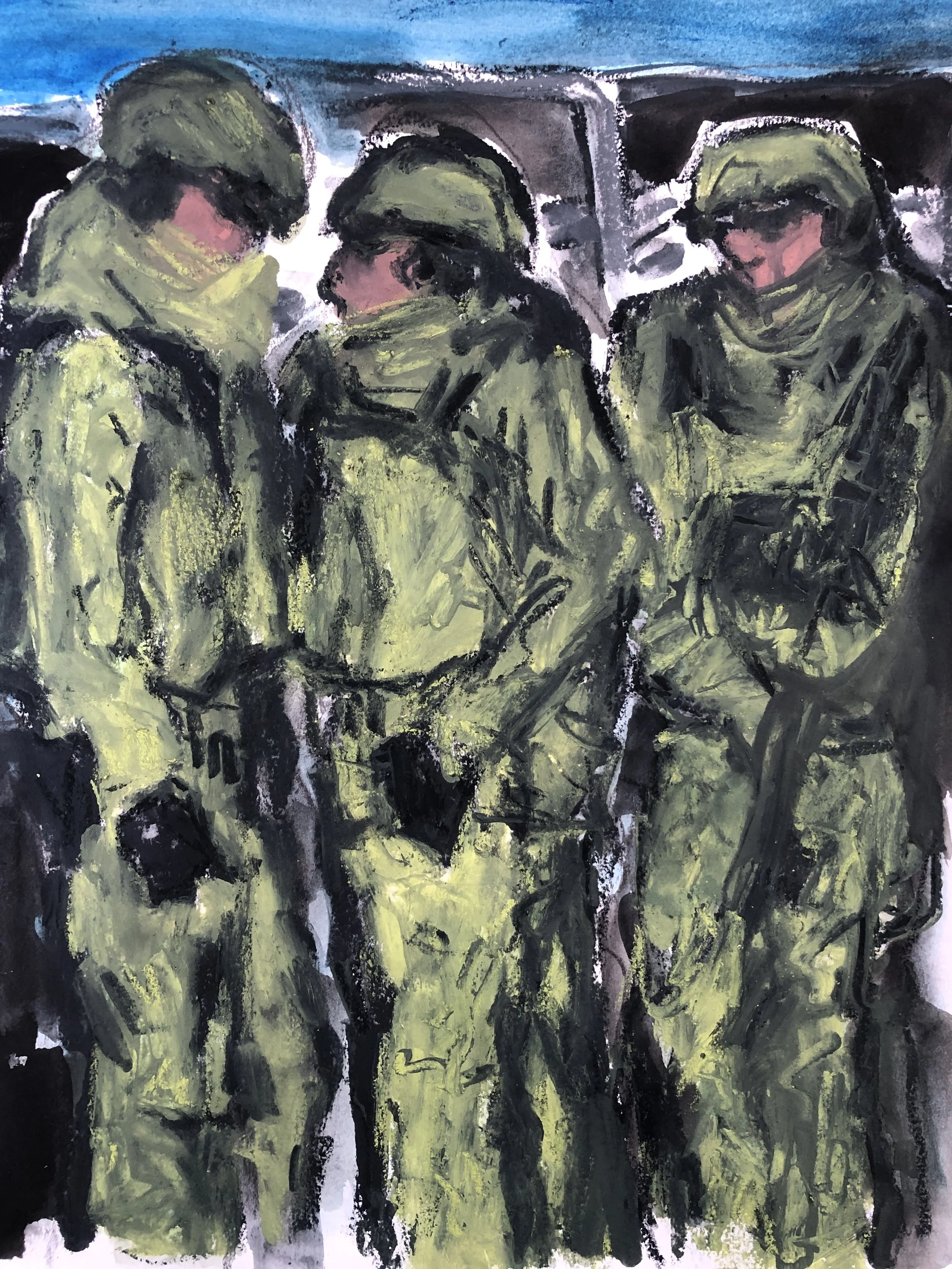
Convictions


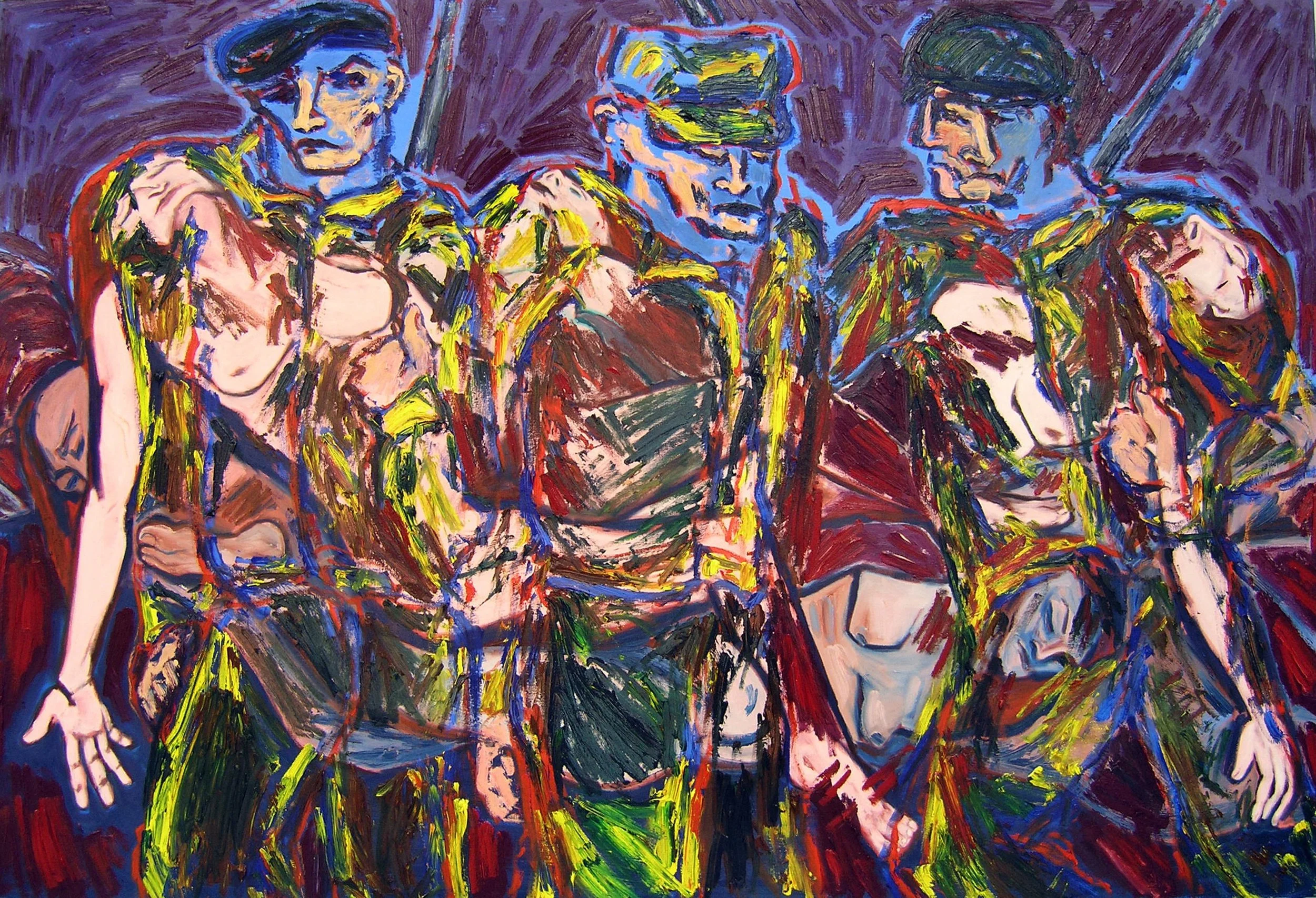


Holy War
Whether an ancient, medieval, or “modern” war, the crusade for a cause, a plot of land or a holy mission demands a price intolerable in human cost. The soldiers spread across the field of “In the Wake” are uniformed in a camouflage of slashing colored strokes—dissonant, clashing green/yellow against violet as nauseating as the scene through which they pass. The violence of rape and murder leaves a pile of women’s bodies in the wake of war. With the posture of invincibility the warriors form a wall across the picture plane.
How war itself transforms young men into soldiers and then into warriors is the exploration of the series of mixed media drawings on unstretched canvas. From the young man’s “Departure” from home and parents, through the process of “Induction,” enduring the “Tour,” and returning in a wheelchair or body-bag for the “Homecoming,” the sweeping suite forms an arc of deforming change.
There is nothing holy or sacred when men take up arms of destruction; indeed, they are themselves also altered by their deeds.
- Jan Wurm


From Drawing Board to Master Plan
There are so many ways in which society implants values and so many paths to particular outcomes, that it is no wonder that we have visual languages that develop different vocabularies to express these aspects of societal norms.
Instilling a willingness to kill may not be as difficult as we might wish to believe. In any case, there are myriad ways in which our society prepares, encourages, and ultimately trains our young to do battle. Traditionally geared to boys and young men, team sports such as football and ice hockey encourage aggression and incorporate an acceptance of pain. The glorification of the tackle and the celebration of the wall-rammed player pinned into crossed-stick submission can be amplified from the playing field to the violence of killing fields.
The noise of video games exploding targets, the speed racing against the rapidly shifting screen image, the adrenalin of the hit rewarded by visual and aural acclaim –all combine to excite to the symbolic destruction. The game – obsessive and in many ways addictive — is desensitizing: the individual, in the real confrontation of the real impact of violence against another human being, can be performing in responses learned at the play console.
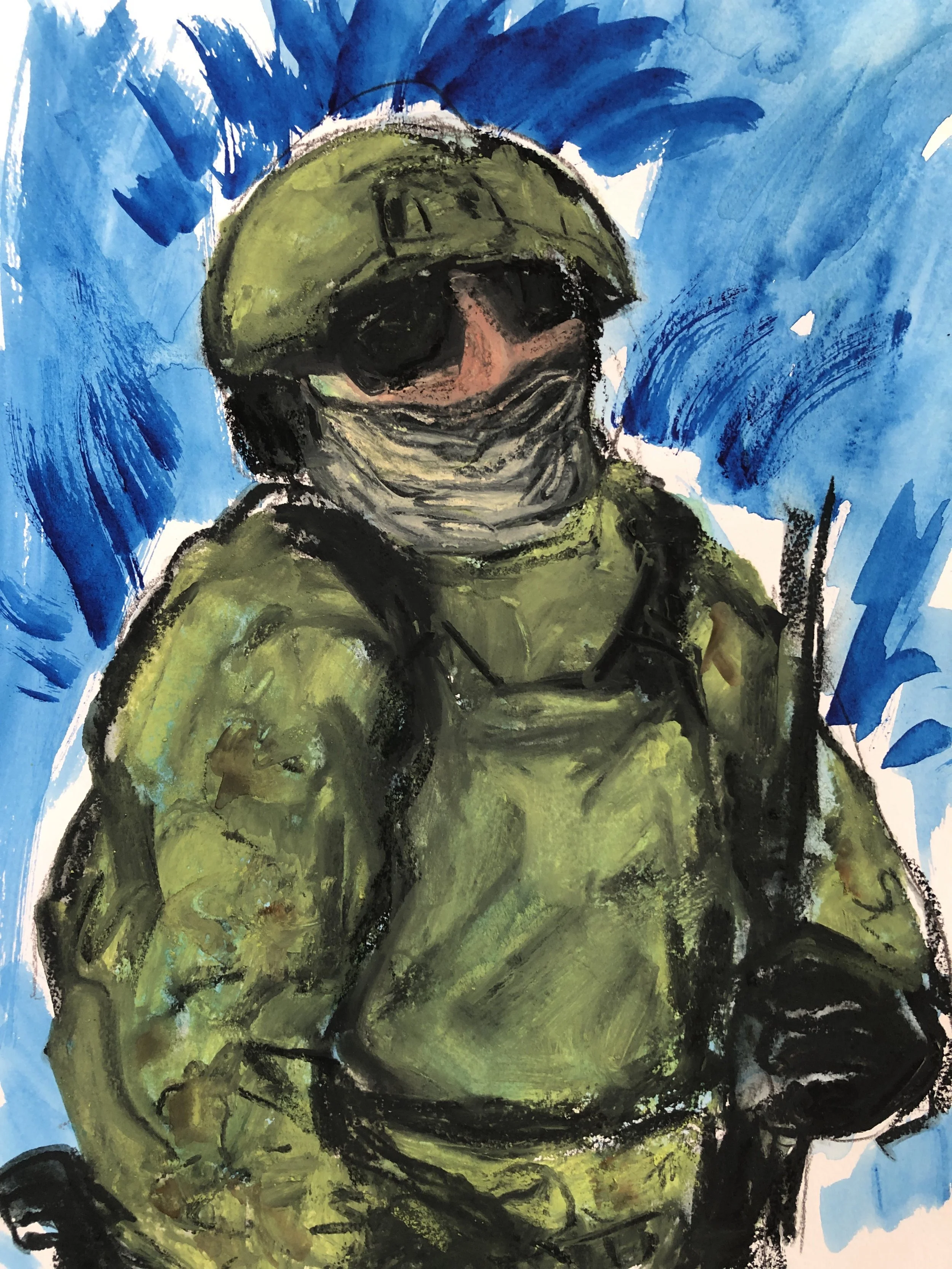
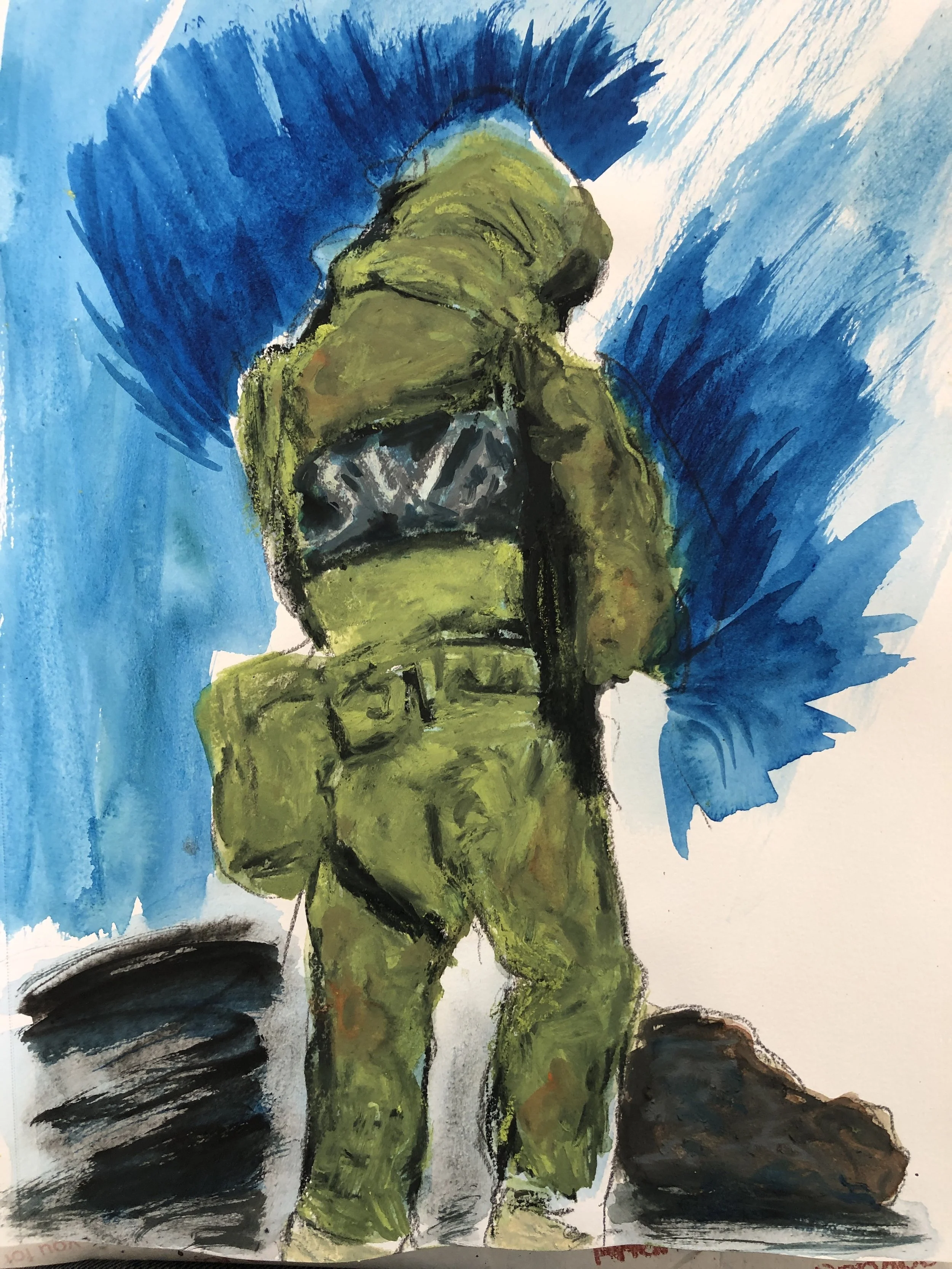
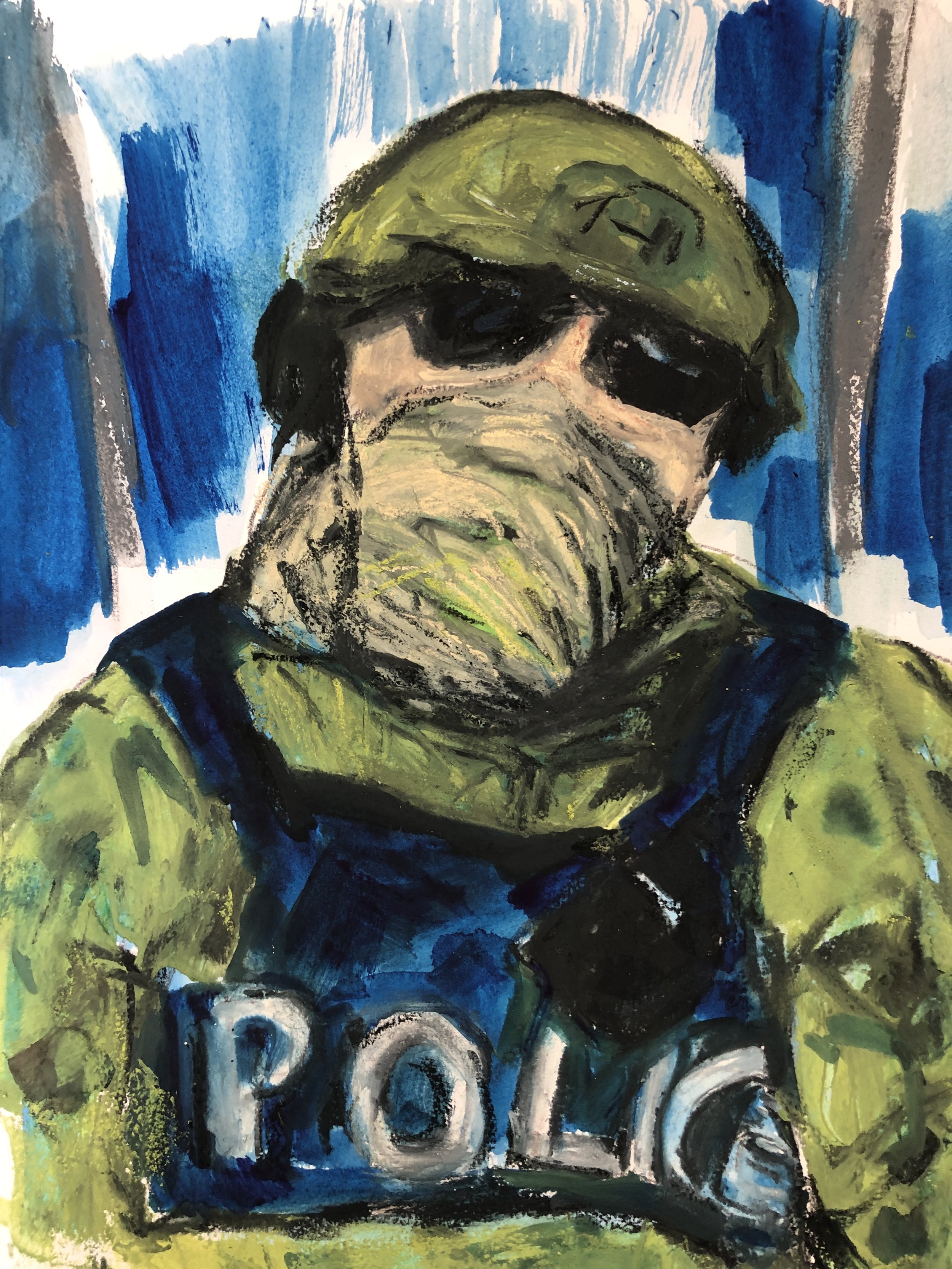
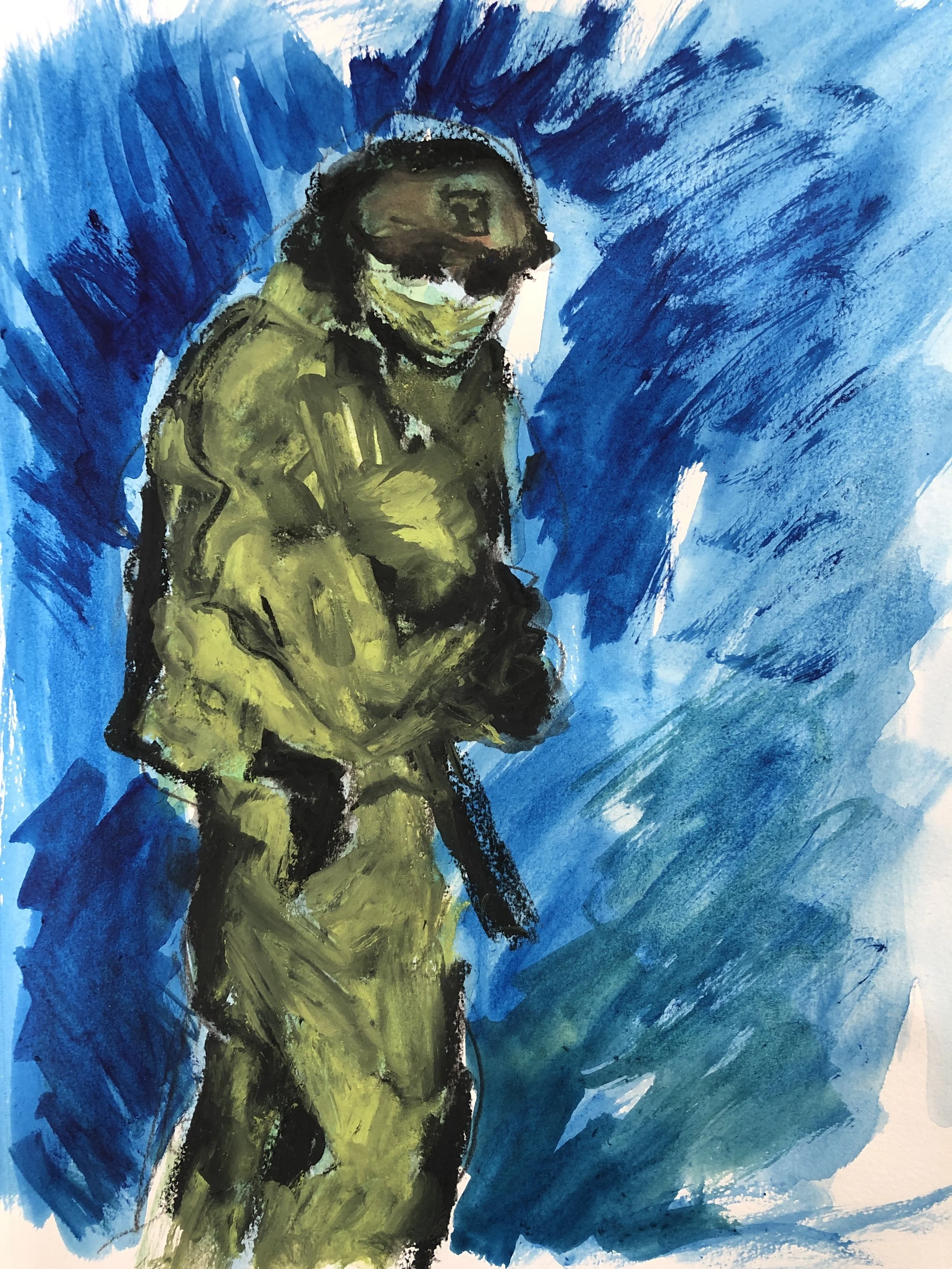
The works on paper, Guards, partake of the vocabulary and conventions of these familiar visual experiences.
The posturing and framing of the combatant in the comic book becomes a visual signal for the power and triumph of an individual. The single figure that dominates the comic book’s single enlarged panel stands alone and places the viewer in the proximity to identity with the heralded. These drawings also isolate the police/federalized national guard/ICE agents--figures of power and domination. The absolute power is understood in the shorthand of radiating deep blue lines.
In groupings, lined up in rows, these figures become the centipede monster –taking on the powers of a beast beyond the fight of any individual. The uniform, the dark glasses, and now the face mask –not only removing the personal, the identifiable, but with that removing responsibility. The actions of the agent carry no personal accountability. And the violence meted out requires not specific judgement or measure. Like a video game, there are no distinguishing, qualified figures or levels of response –just a push of a button…! At any moment the landscape can erupt; like the video screen, the next move is not visible –only the assured immediate response.